


As Triflex UK celebrates 40 years since its incorporation in 1986, Tony Mills, Triflex Roofing Division Director, reflects on the technological advances, testing standards and refurbishment trends that have transformed roofing and waterproofing over the last four decades.
The emergence of liquid applied waterproofing
When Triflex was established in 1986, the UK business consisted of just two people. Four decades later, the UK company has grown to fifty employees as part of a worldwide family-owned group of more than one thousand.
Tony Mills reflects: “Back then the industry was dominated by bituminous waterproofing systems and sheet materials. The challenge for many was that existing waterproofing solutions were difficult to successfully refurbish. Replacing failed waterproofing often required extensive disruption, removal of existing systems and risk to the building below.”
Triflex's liquid applied approach provided an alternative. "Our overlay solutions offered asset owners and specifiers the ability to refurbish and protect existing structures without the disruption that often came with traditional replacement methods," says Mills. "That principle remains highly relevant today."
The first major step change: advancing resin technology
One of the biggest changes over the company's history has been the evolution of waterproofing chemistry. In the early years, Triflex systems were based on advanced flexible unsaturated polyester technology. At the time, this offered advantages over many competing solutions and helped establish the company's reputation for highly durable waterproofing and surfacing systems. However, Triflex recognised that longer-term improvements were possible.
"Around 25 years ago, we made a decision to move towards PMMA technology," explains Mills. "We could clearly see the performance advantages, but also the health and environmental benefits compared with traditional styrene-based polyester systems."
The move represented more than a simple product development programme. It demonstrated a willingness to anticipate future market requirements and investment in Triflex R&D and manufacturing facilities. Now, Triflex PMMA technology is widely recognised for its fast curing, even at low temperatures, inherent hydrolysis resistance, durability and suitability for complex detailing and refurbishment projects across the built environment.
The growth of seamless membranes
During the 1990’s, single ply roofing systems became increasingly common across the roofing market. The addition of plasticisers was common, to provide more malleable properties to single ply membranes.
“Increasingly, many building owners face ageing single ply roofs that still have underlying value but require refurbishment rather than complete replacement,“ Mills explains. “This has created growing demand for overlay systems capable of extending service life and reducing lifecycle costs.”
Triflex has developed specialist expertise in the refurbishment of single ply roofing systems, supported by detailed investigation and testing, including plasticiser migration assessments where appropriate.
The flat roofing refurbishment revolution
Perhaps nowhere has change been more apparent than within flat roof refurbishment. Over the last four decades, the UK's roofing stock has matured, and asset owners increasingly face the challenge of extending the life of existing roofs while minimising disruption to occupants.
"Refurbishment has become one of the most important sectors in construction," explains Mills. "Building owners are looking to maximise the life of existing assets rather than replace them unnecessarily. And contractors now need solutions that fit ever tightening timescales. That requires systems that can be adapted to existing conditions and that starts with understanding the roof."
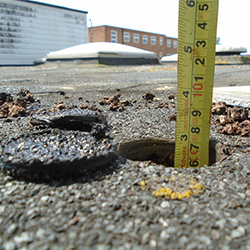
A defining characteristic of the Triflex approach, the company undertakes roof investigations, substrate assessments and compatibility testing before overlay recommendations are made. Such projects are assessed individually to understand the existing waterproofing build-up and condition, alongside appropriate condensation risk analysis.
Raising standards through testing
As the market and regulators increasingly demanded evidence of long-term performance, testing moved from a desirable benefit to a critical requirement. Recognising this trend, Triflex invested in specialist testing capabilities to support its scope of system applications. One notable example was the acquisition of in-house dynamic crack-bridging testing equipment, enabling performance testing to various standards at temperatures as low as minus 40°C.
"At the time, it was a significant investment," explains Mills. "But we have always believed that performance claims should be supported by robust testing and evidence."
This commitment to testing has allowed Triflex to develop systems that meet the highest standards and levels of certification across Europe. And it’s not only in product development that testing is evident, but also at a project level, from plasticiser migration testing for single ply overlays to asphalt core analysis.
The impact of certification and changing regulations
For liquid-applied roofing systems, certification and independently verified performance data have become increasingly important tools for specifiers seeking confidence in long-term waterproofing performance. The company played an active role in the development of ETAG 005, the European assessment framework for liquid-applied roof waterproofing systems.
"We were closely involved in the technical committees and became the first company in Europe to achieve ETAG 005 approval," says Mills. "Those high standards helped establish many of the performance expectations that exist today."
Over the last 40 years, regulation has played an increasingly important role in shaping roofing and waterproofing specifications. The need for thermal improvement in response to Part L regulations is driving change across the industry.
Mills adds “This means that alongside strip and replace new warm roof build-ups, hybrid overlay systems have developed, which reuse some or all of the existing build up for a more sustainable approach that is underpinned by a deep understanding of the roof build up and condensation risks.”
Looking ahead
Over the past 40 years, advances in technology, testing standards and refurbishment have reshaped the roofing industry. As Triflex celebrates this milestone anniversary, the focus is firmly on the future.
From the emergence of liquid applied waterproofing and advances in resin technology, through to modern refurbishment strategies and performance-led specification advice, Triflex has evolved alongside the roofing industry for four decades. As the sector continues to adapt to new challenges, the company's focus remains unchanged: delivering proven waterproofing solutions through innovation, testing and technical expertise.